Removal, trimming, storm cleanup, and stump grinding across Orangeburg County. Free written estimates before any work.
Call (555) 555-5555Or call — we answer. No obligation, honest advice.
The Edisto takes its time through this county. The weather does not. Summer squall lines cross the Midlands with straight-line winds that arrive with almost no notice, tropical systems wander up from the coast having lost their eye but kept their rain, and every few winters an ice event comes through and coats everything standing.
That last one is the reason tree work here is not the same job it is on the coast. Wind pushes a tree sideways, and a tree has spent its whole life growing to resist exactly that. Ice does something a tree has no answer for: it adds weight, straight down, to every twig and limb at once. A quarter-inch of accumulation can put hundreds of extra pounds into a canopy that never grew to carry it, and the limbs that fail are not the weak-looking ones - they are the long, horizontal ones that were perfectly sound in every other kind of weather.
Orangeburg County's trees fall into three groups, and each takes a different view of all that. The older neighborhoods near the colleges are shaded by oaks that have been there for generations. Rural parcels carry pine stands, planted or volunteer. And scattered across the county are pecan groves that outlived the farms they were planted for - lined up in rows nobody remembers laying out, now standing next to houses built decades later.
The approach is plain. Look at the tree, say honestly what it needs, write the estimate down, and show up on the day. Cleanup and haul-off sit inside a removal price rather than arriving after it. And when the answer is that a tree is sound, that is the answer you get.
The plan is settled before anything is cut: where each piece can go, what is underneath, and how the weight redistributes as the tree comes apart. On a mature pecan that question matters more than usual, because the wood is brittle enough that a limb can let go earlier in the cut than it would on an oak.
The site gets raked before we leave. Chips cleared, debris hauled, and the yard left looking like the tree simply is not there any more.

Removal, trimming, and stump grinding cover most of what a county property needs, plus response for when a squall line or an ice event rearranges things.
Dead, damaged, and hazardous trees taken down safely, including brittle old pecans and pines close to structures. Cleanup and haul-off included.
Deadwood out, clearance over roofs and drives, and weight reduction on the long horizontal limbs that ice finds first. Cuts placed at the branch collar.
Stumps taken below grade so ground can be replanted, sodded, or mowed across without working around it every week.
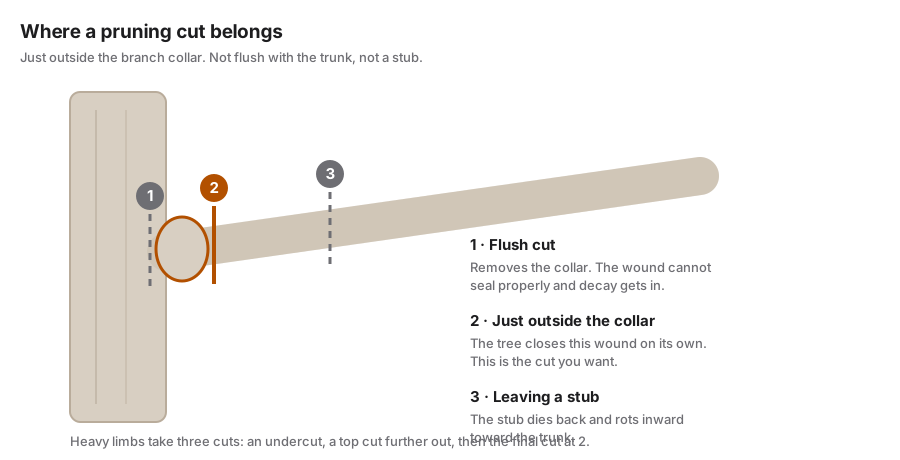
One detail separates pruning that helps a tree from pruning that slowly kills it, and it is a matter of an inch or two. At the base of every limb there is a slightly raised ring where the branch meets the trunk. That ring - the branch collar - contains the tissue the tree uses to grow over the wound left behind. Cut just beyond it and the tree does the healing itself.
Cut inside it, flush to the trunk, and the healing tissue goes with the limb. The wound stays open and decay moves down into the trunk over the following years. Leave a long stub instead and it dies back and rots inward, arriving at the same destination by a slower road. Neither shows up the same season, which is why bad pruning is rarely traced back to whoever performed it.
There is a third rule that matters more here than in most places: heavy limbs come off in three cuts. Undercut, then a relief cut further out to shed the weight, then the finish cut at the collar. On brittle-wooded species like pecan, skipping that sequence means the limb tears free early and takes a long strip of bark down the trunk with it.
It is worth being specific about ice, because it is the failure mode people here prepare for least and it behaves nothing like wind. Ice accumulates evenly on every surface a tree has - every twig, every branch, the whole canopy at once. The load is vertical and it is enormous relative to what the tree grew to hold, and unlike a wind gust it does not pass in a few seconds. It sits there for hours or days.
That changes which limbs fail. In wind, the parts that go are usually already dead or already weak. Under ice, the parts that go are the long horizontal limbs and the wide-spreading crowns - the healthiest, most impressive growth on the tree, because that is where the most surface area is. It is why an ice event can take apart a tree that looked perfect the day before.
Species matter enormously. Pecan is brittle by nature, with branch unions that were never strong to begin with, and pecans lose limbs in ice events that oaks shrug off. Pines have their own problem: tall, top-heavy, and with a habit of bending under load until they either recover or do not. Water oaks sit somewhere in the middle and tend to be over-represented in the aftermath because so many of them are older than the houses they shade.
The useful response is not to panic in December. It is to reduce what a canopy has to carry before the season - take out the deadwood, address limbs that have grown out longer than their attachment can reasonably support, and deal with anything already cracked. A canopy that has been thinned sensibly carries an ice load far better than one that has been left alone for twenty years, and the work costs a fraction of what the failure does.
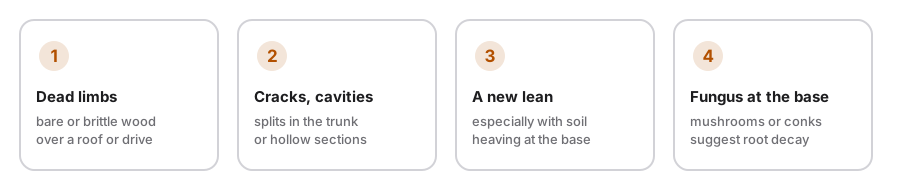
None of these condemns a tree on its own. All of them are worth checking in a mild month rather than discovering under an inch of ice.
Same sequence every time, from one limb over a driveway to a grove that needs thinning.
Somebody looks at the actual tree and writes the number down, with cleanup and haul-off inside it rather than added at the end.
A brittle tree is not automatically a doomed tree. We will tell you which limbs are the problem and whether reduction solves it before anyone talks about removal.
Debris hauled, chips cleared, ruts avoided. A finished job should leave nothing behind but the space where the tree was.
Drive the county and you will see them - rows of pecans standing in what is now somebody's back lot, planted with a spacing that only makes sense if you know a farm used to be there. Around Orangeburg these trees are a genuine local specialty, and they present a set of problems that ordinary yard trees do not.
They are old, frequently far older than the houses near them. They were planted for nut production rather than for standing next to a roof, which means they were never pruned for structure. Pecan wood is brittle and its branch unions are weak, so limb drop is routine rather than exceptional. And decades of no maintenance means most of them carry substantial deadwood high in the canopy where nobody looks.
None of that makes them trees to remove on sight. A well-managed old pecan is a beautiful thing and can stand for a long time yet. What it needs is honest triage: the deadwood out, the over-extended limbs shortened back to something their attachment can carry, and any limb with a cracked or included union dealt with directly. That is usually a trimming job rather than a removal, and it is worth getting a second opinion if somebody has told you otherwise.
One practical note if you have several. Groves are best worked as a group rather than one tree at a time - the crew is already set up, the equipment is already in the right place, and the price per tree drops considerably. If you have a row of six that all need attention, say so on the first call rather than starting with one.
Orangeburg is the base, and the service area reaches across the county - Santee, Holly Hill, Bowman, Branchville, Cordova, North, Neeses, Elloree, Eutawville, and Vance. That covers the shaded college-area streets, the lake-adjacent lots down toward Santee, and the farm country where pine edges and pecan rows frame every field.
Travel is part of the quote toward the far corners of a county this size, and we will say so on the phone rather than adding it to the invoice afterwards. If you are just outside the list below, it is still worth calling.

Every kind of weather this county gets is seasonal and predictable in timing if not in severity. Squall lines come in summer, tropical remnants in late summer and autumn, ice in the depths of winter. What that means practically is that there is always a quiet stretch to do the work in, and the work is always cheaper and easier to schedule then.
A canopy with its deadwood removed has materially less to shed in any of those events. A limb already growing out longer than its union can support is a scheduled trim in April and an emergency in January. The difference in cost between those two is large, and the difference in what happens to your roof in between is larger.
When something does come through, priorities sort quickly. Trees on houses, on vehicles, or blocking a drive come first. Anything in contact with a power line is a utility call before it is a tree call and not something to approach at any distance. A tree lying across an open yard is the least urgent thing on the list no matter how it looks. And after any significant event, out-of-area crews turn up looking for cash work - the protections are the same ones worth applying to anyone, including us: scope in writing before work starts, no large deposit up front, and a certificate of insurance sent to you directly by the insurer rather than shown as a photocopy.
Estimates are free and in writing. Removal prices on size, species, and access above all - a pine that can be dropped whole in an open field is a different job from the same pine between a house and a shed. Trimming prices on scope, stump grinding on diameter and count. None of that can be quoted honestly over the phone, which is why somebody comes and looks.
Call (555) 555-5555 for removal, trimming, storm cleanup, or stump grinding anywhere in Orangeburg County. If there is a limb you have been watching every time the forecast mentions ice, the time to deal with it is a mild week in spring.
Tell us what you need and we'll get back to you with a real answer. If it's an active backup or standing water over the field, calling gets you a faster response.
Call: (555) 555-5555
Area: Orangeburg, SC and Orangeburg County